Which printing method will perfectly showcase your design on the packaging? A poor choice can lead to dull colors, inconsistent brand imagery, higher unit costs, or missed market opportunities; conversely, the right choice ensures structural integrity and healthy profit margins.
Crown Win Packaging produces millions of packaging boxes annually across sectors such as cosmetics, food, tea, scented candles, and subscription products. In this article, we will analyze the four mainstream printing methods and provide a clear decision-making framework. We will also share a real-world client case study demonstrating how selecting the right printing method can reduce costs.
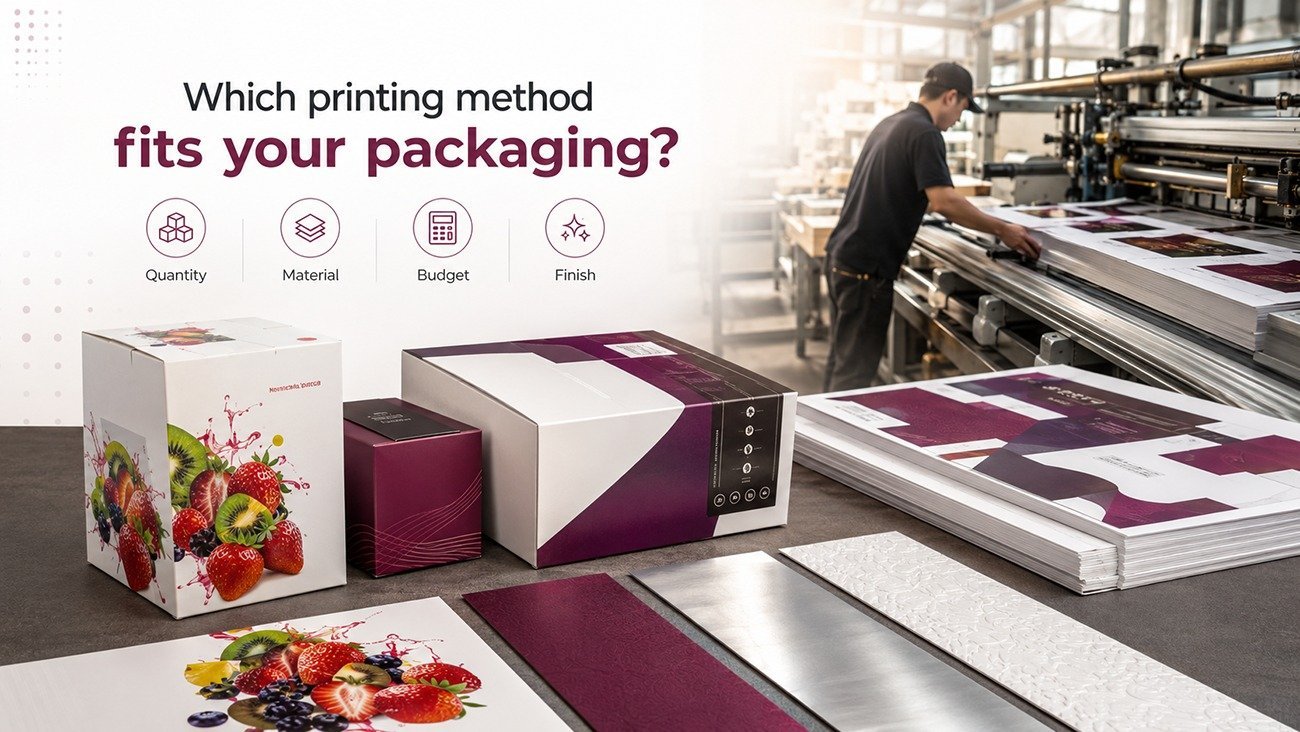
Four Mainstream Packaging Printing Methods
1. Offset Printing
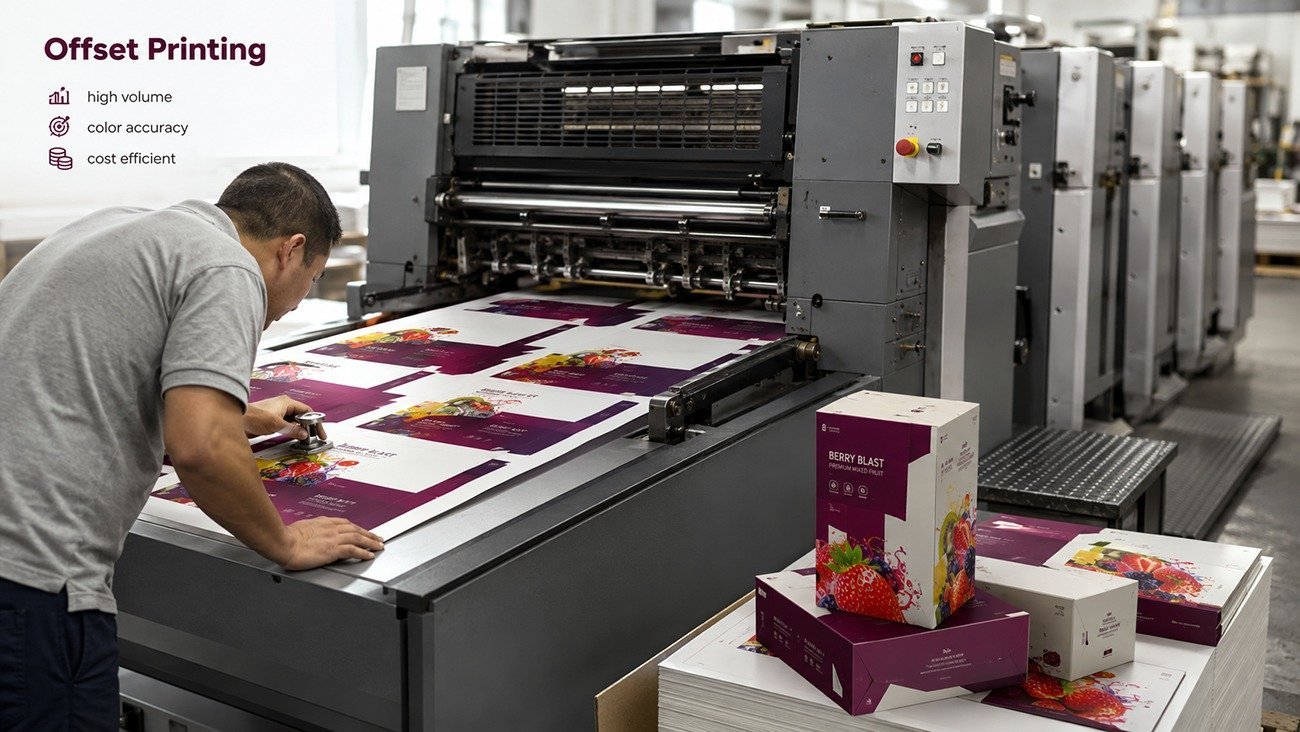
Offset printing transfers ink from a printing plate to a rubber blanket and then onto the substrate. It is the workhorse for producing high-end folding cartons and retail packaging.
Best for: High-volume production (over 5,000 units), fine detail reproduction, Pantone spot color matching, and coated paperboard printing.
Advantages: Exceptional color accuracy, smooth gradients, and cost-effectiveness at scale.
Limitations: High plate-making costs; expensive for small batches; longer lead times for plate changes.
2. Flexographic Printing
Flexography uses flexible photopolymer plates and fast-drying inks, making it ideal for producing corrugated boxes, paper bags, labels, and flexible packaging.
Best for: Large-scale production of corrugated boxes, kraft paper, and continuous roll materials.
Advantages: High production speed, suitability for both porous and non-porous surfaces, and durable ink.
Limitations: Detail reproduction is slightly inferior to offset printing; low plate-making costs make it suitable for high-volume runs.
3. Digital Printing
Digital printing eliminates the need for plates, sending digital files directly to the printing equipment—examples include inkjet printing and toner-based imaging systems.
Best for: Small-batch production, variable data printing, personalized packaging, and rapid prototyping.
Advantages: No plate-making required, quick setup, and support for version differentiation and serial number printing. Limitations: Higher cost per unit for large-volume production; potential for color inconsistency during long print runs.
4. Gravure Printing
Gravure printing involves engraving the image directly onto a printing cylinder, enabling stable, high-quality results at very high speeds.
Suitable for: Ultra-high print volumes (over 100,000 units), flexible packaging films, composite materials, and premium finishes.
Advantages: Excellent color consistency; rich, saturated solid color areas; ideal for films and metal foils.
Limitations: High costs for cylinder production and equipment setup; cost-effective only for large-scale production.
How to Choose the Right Printing Method
Before deciding on a printing method, ask yourself these five questions:
Print Volume — Under 1,000 units? Choose digital printing. 1,000–10,000 units? Choose digital or offset printing. Over 10,000 units? Choose offset or flexographic printing. Over 100,000 units? Choose gravure printing.
Substrate Material — Coated paperboard is suitable for offset printing; corrugated board and kraft paper for flexographic printing; films and metal foils for gravure printing.
Color Requirements — Offset or gravure printing is preferred for critical brand colors (e.g., Pantone) or photorealistic images.
Turnaround Time — Digital printing is the best choice for urgent orders; offset and gravure printing require preparation time for plate or cylinder making.
Post-printing Requirements — Processes such as hot stamping, embossing, spot UV, and soft-touch lamination work best with offset-printed paper boxes.
Simple Guideline: Choose the printing method that offers the lowest cost per unit based on actual volume, rather than blindly pursuing the most advanced technology.
Real-world Client Case Study:
A specialty tea brand commissioned Crown Win Packaging to produce 8,000 rigid gift boxes; the design featured hot stamping, logo embossing, and six different regional SKU versions. The original supplier insisted on using offset printing for all SKUs, resulting in plate-making costs and minimum order quantities (MOQs) that far exceeded actual volume requirements.
Our Recommendation:
Switch the outer sleeve to offset printing to ensure a premium look for the high-end graphic designs and hot-stamping details.
Use digital printing for the inner cards across the six different SKUs, eliminating the cost of producing six sets of printing plates.
Consolidate all orders into a single production run to reduce labor costs associated with equipment setup.
Results:
Unit costs were reduced by 28% compared to the initial all-offset quote.
Production time was cut by four days, as digital printing for the inner cards eliminated the plate-making stage. Our online quality control (QC) system verified that all 8,000 units were free of color variations.
The brand placed a repeat order within 90 days and increased the production volume to 25,000 units for the subsequent batch.
Why Choose Crown Win Packaging?
Selecting the right printing process is only half the battle—the final execution determines how your packaging performs at retail. Here are our unique advantages:
18 years of printing experience, serving sectors such as cosmetics, food, tea, scented candles, and subscription boxes.
In-house offset, flexographic, and digital printing capabilities—we recommend the best process for your project needs rather than simply pushing the equipment we happen to own.
Comprehensive quality certification systems, including ISO 9001 certification, FSC-certified paper sourcing, and audited production processes.
One-stop post-press finishing services: hot stamping, embossing/debossing, spot UV, soft-touch lamination, die-cutting, and box gluing.
Digital printing MOQs as low as 500 units, with scalable capacity; offset and flexographic printing can support production runs of up to millions of units.
Dedicated project engineers who rigorously review every design file before plate making to ensure print readiness.
Conclusion
Choosing the right printing method requires balancing volume, substrate materials, color accuracy, lead times, and budget. There is no single "best" method—only the solution that is perfectly suited to your specific project. If you are unsure which technology suits your next packaging project, simply send us your design files and estimated quantities. Our engineers will recommend the best solution within 24 hours and provide a transparent cost comparison analysis.